What's New: Spruce Up FAQs
At ECI, we are making meaningful changes to how Spruce works to address your requirements — changes that remove longstanding data friction, improve everyday technical performance, and give you more flexibility and control over how the application supports your business. We call this modernization process, Spruce Up!
The Spruce Up changes will prepare your business for the future... for the migration from the IBM Cloud platform to Amazon Web Services (AWS). This move will allow your workstations to run the application locally, which is faster and more reliable, and will scale better during busy workdays. This change includes printers, cash drawers, POS terminals, and card readers, which will also operate based on local instructions, rather than through a cloud server, which is important during busy times in the store. Most of the setup is done behind the scenes, so you can add printers, payment devices, and cash drawers locally, bypassing the complication that remote desktop required.
We are starting this transition with Remote Client (Custom) Pairing and Rapid Entry. As we roll out these changes, we will add to this page to address any new issues you have. You can contact us at any time using the DocsHelp_LBMH@ecisolutions.com to pose your questions.
Click the link below to access these FAQs quickly:
Remote Client (Custom) Pairing FAQs
General Spruce Up FAQs
Setup effort: None — this section contains background information about the whole transition process and applies to each step you are on.
Will the migration disrupt transactions we have in progress?
No. Anything you already have in process, stays in process. The first step only replaces the desktop icon — if you are already working in the application, you will keep working without interruption and will only see a change the next time you log in. The Remote Client Utility update happens in real time, so there is no interruption in service.
Should we delete the old log in desktop icon?
No. When we enable Rapid Entry, we replace your current
I can log in successfully using the new ECI icon. If the old login icon is still on my desktop, what do I do?
If you can log in successfully using the new icon, you can move the old
Can we pilot the transition with one or two workstations before we roll it out to everyone?
Yes. For some processes, like Remote Client (Custom) Pairing, we encourage you to start small, typically, start with a workstation that does not have a cash drawer or credit card device associated with it. Then move to one with those peripheral devices attached. When you feel comfortable that the process is working, roll it out to the rest of the first branch. Then, you can expand to other branches.
No. For other processes, such as Rapid Entry, are branch-specific, and enabling this process updates all workstations in the same branch at once.
We will provide comprehensive instructions to help you navigate these changes safely and effectively.
Will running our workstations on Windows 10 be a problem?
There are no known issues with adding these processes to workstations running Windows 10 at this time. It does not affect the new pairing or rapid entry processes using the new desktop icon.
Can we use the current setup processes instead of migrating?
Unfortunately, No. The infrastructure that the current hosted setup depends on is being retired, so these new transition processes are required. We've built the transition to be as low-friction as possible, and we are confident that the new platform will be a genuine improvement. We are here to help every step of the way!
Remote Client (Custom) Pairing FAQs
Setup Effort: Light — installs in the background, no downtime.
We begin this process by implementing Remote Client (Custom) Pairing, which is a background service that keeps each workstation connected to  icon in the Left Menu confirms it is running.
The setup effort for the Remote Client (Custom) Pairing is light, because it largely installs in the background and causes no downtime.
Here are some questions that our beta partners have asked and we have answered:
Is Remote Client manually installed on every workstation?
Yes. The Remote Client utility has always been installed on every workstation. The new Remote Client (Custom) Pairing process ensures each workstation is updated regularly and automatically synced with your application version. You complete this process once for each workstation, and it does not have to be done again.
You will need to perform this step whenever you add new workstations to your network.
Will the workstation be disconnected during installation?
No. You are never disconnected from the cloud. Future updates occur in the background, typically during off hours, but can also be initiated manually using the Remote Client Utility > Update tab.
Can I use Spruce while installing/pairing with Remote Client?
Yes. There is no loss of connectivity during this process.
What changes after the Remote Client upgrade is installed?
After the upgrade is installed, this Remote Client icon displays in the Left Menu. If this icon displays  instead, follow the steps here to complete the pairing process on each workstation that displays it. When this process completes successfully, the Remote Client can update and upgrade your workstation each day automatically.
After implementing this process, will I still have to update every PC when a new version is released manually?
No. After the Remote Client process is upgraded using this process, all software updates are delivered automatically to each workstation through the Remote Client Utility. This process runs as a background Windows service and will require no manual intervention.
Does a PC need to be left on overnight to receive updates?
No. The Remote Client Utility will upgrade each workstation the next time the user logs into it. Remote Client checks for updates overnight by default at 2:00 a.m. each day. We recommend you leave the Automatic Update setting as it is, but you can adjust it manually.
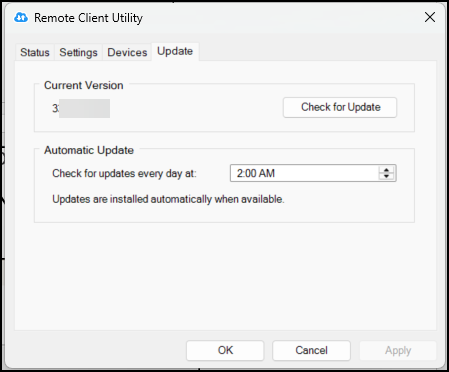
Remote Client Utility > Update Tab
Does POS Assured use the same Remote Client Utility?
Yes. It is the same program, but POS Assured registers as a different type.
After I install Remote Client on my workstation, can I connect local printers to it?
Yes. After the Remote Client (Custom) Pairing process is complete, you can install and connect to printers locally. You should see a significant improvement in performance.
Rapid Entry FAQs
Setup effort: Moderate. This is a one time change to your log in and desktop icon.
Rapid Entry replaces the RDP shortcut on your desktop with a new ECI sign-on icon, which is turned on one branch at a time. The Rapid Entry process is described here > Rapid Entry. Your previous RDP shortcut is preserved in a backup folder, not deleted.
Here are some questions you may be asking about the Rapid Entry process.
What is the setup effort for Rapid Entry?
There is a one-time change to your log in and desktop icon, and the branch setup required to begin. Rapid Entry replaces the RDP shortcut on your desktop with a new ECI sign-in icon; the log in screen has a newer look but works exactly the same way. Your previous RDP shortcut is preserved in a backup folder and is not deleted, in case you want to return to it.
Will my log in screen look different?
Yes. The sign-on box will have a newer look but it works just the same.
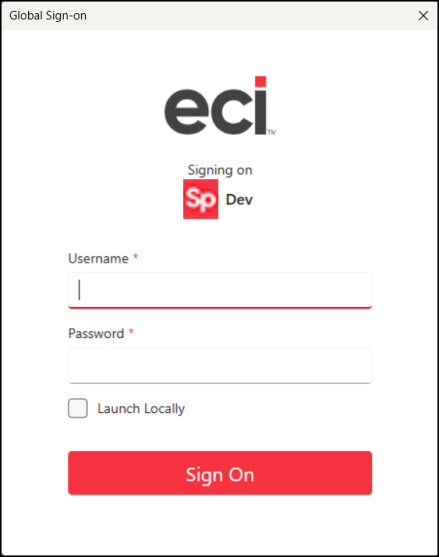
Will my icon look different?
Yes. It will say ECI Sign-on.

My RDP launch icons are missing from my desktop! Can I get them back?
Yes. These icons are stored in a backup folder.
How does the Rapid Entry process benefit us?
Rapid Entry introduces a global sign-on that gives you more flexibility to route your connection behind the scenes — so when the back-end infrastructure moves, the change is seamless to you. This process removes the dependency on individual RDP sessions and enables automatic updates and upgrades, without changing your day-to-day workflow.
Converting Cloud-Based Printers to Local Printer Settings
Setup effort:Moderate to install — Significant to run locally, with printer setup required on each workstation.
When you run locally, printers are installed on each workstation rather than shared from the cloud. Print jobs are passed to devices through the Remote Client utility. We developed a process to help you convert your cloud-based devices for local use, which is described in this help topic.
Will there be exceptions to this device processing conversion?
No. The current requirement is to install printers locally for that workstation.
Can I keep my VPN with ECI?
No. The VPN service will no longer be available at a to-be-determined time.
How will my printers communicate going forward if I currently use a VPN?
When using the application as ‘Local’ operation, printing will send through the workstation’s Remote Client Utility to the printer.
Will I need to install printer drivers locally on each station?
Yes. We are providing a conversion process from the cloud system to your local workstation for your existing devices, which is covered here.
If I install a printer driver locally, how do I connect that printer with the software when I need to print from POS?
The printer is added as a device within Spruce using the device setup instructions in the help system here.
What does the Setup Printers do under Devices in the Remote Client Utility?
In the Remote Client Utility > Devices tab, there is a tool that simplifies installing your existing Cloud-based printers locally. This provides the list of currently configure printers that you can select, download, and install on your local PC. This process is described here.
Managing printers on every workstation sounds like a lot of overhead — is there help for that?
Running Edge Client locally does require printers installed on each workstation. To reduce the work, we are building a utility that converts your cloud printers to local printers on each PC. We recognize this is a significant effort for sites with many workstations or multiple locations.
What happens to printer preferences — my local printer defaults to double-sided, but Spruce needs single-sided?
We are confirming how local printer defaults interact with Spruce print preferences and will document the recommended setup. This process is described here.
Will remote or home users still be able to print to an in-office printer once we move off VPN?
Yes — you won't lose remote printing. What changes is where the setup happens. Today, that connection runs through our hosted servers; going forward, when printers and stations are configured locally, rather than through a cloud request. Once the application is running locally on a machine, it no longer needs VPN or Remote Client to reach network printers or folders — it simply sees your local network directly, the same as any other application installed on that workstation. For the specific case of a remote or home user printing to an in-office printer, that becomes a general remote-access question rather than a application-specific one — standard remote desktop or remote print tools can handle that piece, independent of anything the application requires.